
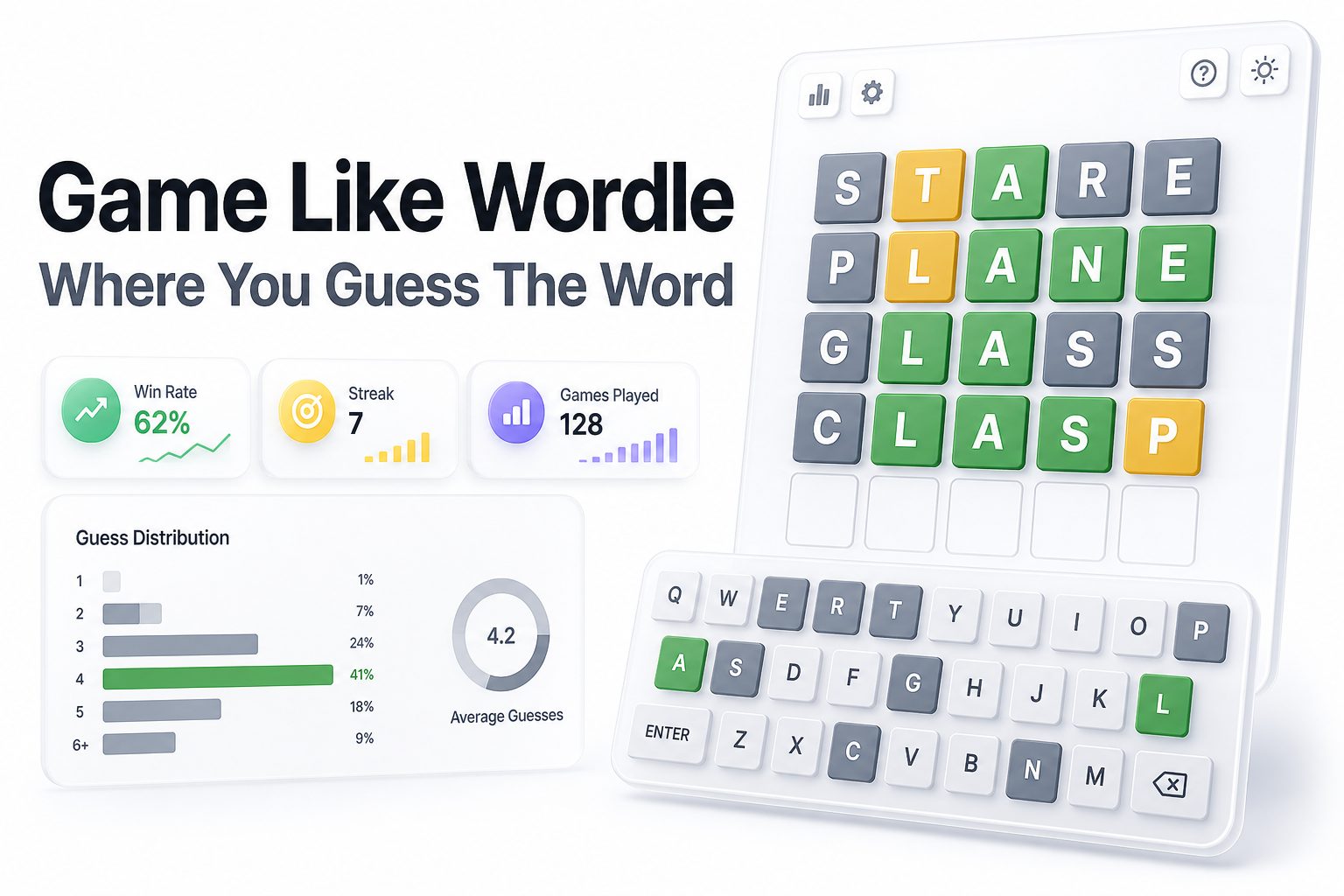
If you have ever finished your daily Wordle and immediately wanted another puzzle, you are not alone. Many players search for a game like wordle where you guess the word because the format hits a rare balance: quick to play, easy to learn, and satisfying when the answer finally clicks. The appeal is not just the green and yellow tiles. It is the small mental challenge of narrowing possibilities with every guess.
Word-guessing games have grown far beyond one daily five-letter puzzle. Some use longer words, themes, clues, unlimited rounds, multiplayer races, or clever twists on spelling and logic. Whether you want something relaxing with your morning coffee or a tougher puzzle that tests vocabulary, there are plenty of strong options. This guide covers what makes these games work, how to choose the right one, and which features matter most for long-term play.
Why Word-Guessing Games Became So Popular
A good word puzzle gives players a clear goal without demanding a long time commitment. You type a guess, study the feedback, and adjust your next move. That simple loop feels rewarding because every attempt teaches you something useful about the hidden answer.
The best games also create a shared daily routine. Players compare results, talk about tricky letters, and return the next day for a fresh challenge. That social layer turns a private puzzle into a small conversation, which helps explain why the format remains so popular.
What Makes a Wordle-Style Game Worth Playing
A strong word game needs fair rules, clear feedback, and answers that feel reasonable once revealed. Players should lose because of choices, not because the word list is strange or the hints are vague. Fairness matters more than flashy design in this genre.
Replay value also depends on variety. Some players want one carefully chosen daily puzzle, while others prefer unlimited rounds. A game like wordle where you guess the word becomes more enjoyable when it offers enough challenge without making the experience feel random or frustrating.
Key Features to Look For
- Clear color or clue feedback after each guess
- A fair dictionary with common, recognizable answers
- Mobile-friendly controls and readable tile layouts
- Daily mode, unlimited mode, or both
- Shareable results that do not spoil the answer
- Difficulty options for casual and advanced players
- Minimal distractions, pop-ups, or forced sign-ups
- Smart keyboard indicators for used letters
Best Types of Games Like Wordle
The most familiar alternatives keep the core idea intact: guess a hidden word in a limited number of tries. These games often change the word length, answer list, or number of guesses. They are ideal if you like Wordle but want more daily puzzles.
Other games take a bigger creative turn. Some include clues, categories, music, geography, math, or multiple words at once. These variations work well for players who enjoy deduction but want more texture than a standard five-letter challenge.
Daily Word Games for a Quick Routine
Daily word games are perfect for players who like a fixed puzzle habit. Because everyone gets the same answer, the experience feels shared. You can compare scores without revealing the solution, which keeps the puzzle social but spoiler-free.
The limitation is that most daily games end quickly. That can be a strength if you want restraint, but frustrating if you want extended play. Pairing two or three daily games can create a satisfying puzzle routine without taking over your schedule.
Unlimited Word Games for Longer Sessions
Unlimited word games remove the one-puzzle-per-day limit. You can play several rounds in a row, practice opening guesses, and sharpen your letter strategy. This format suits players who treat word puzzles as a hobby rather than a short break.
The risk is fatigue. When puzzles are endless, weak word lists or repeated patterns become more noticeable. Choose games that maintain answer quality and give you a reason to keep playing beyond simply starting another round.
Daily vs Unlimited Word Games
Format | Best For | Main Benefit | Possible Drawback
Daily puzzles | Short routines | Shared answer and anticipation | Only one puzzle per day
Unlimited puzzles | Practice and longer play | Play as much as you want | Can feel repetitive
Themed puzzles | Fans of categories | More context and personality | May require topic knowledge
Hard mode puzzles | Skilled players | Stronger deduction challenge | Less forgiving mistakes
Multiplayer puzzles | Competitive players | Fast, social gameplay | Pressure can reduce reflection
Popular Wordle Alternatives Worth Trying
There are many choices, but the best Wordle alternatives tend to respect the original appeal. They stay simple, reward logic, and avoid unnecessary clutter. Games such as Dordle, Quordle, Octordle, Absurdle, and themed guessing games each serve a slightly different mood.
If you want a familiar start, try a game that changes only one rule. Guessing two words at once or solving with unlimited attempts can feel fresh without becoming confusing. Once you know your preferences, more unusual variations become easier to judge.
Multi-Word Puzzle Games
Multi-word games ask you to solve two, four, or even eight answers at the same time. One guess applies across several boards, so every word choice carries more weight. These games reward planning because a useful guess can reveal information in multiple places.
They can feel demanding at first, especially if you are used to focusing on one answer. The trick is to avoid chasing one board too early. Use broad guesses to gather letters, then finish the easiest boards before the remaining options tighten.
Themed Guessing Games
Themed games narrow the answer pool around a subject such as countries, movies, sports, songs, or vocabulary categories. That added context changes the challenge. You are not just testing spelling patterns; you are using memory and subject knowledge.
These games are especially good when you want personality. A music-based or geography-based puzzle can feel more distinctive than another five-letter word clone. For related recommendations, see [Internal Link: Best Word Games Online] for more puzzle formats and casual brain games.
Tips for Choosing the Right Game
- Pick daily puzzles if you like structure and restraint.
- Pick unlimited puzzles if you want practice or longer sessions.
- Try multi-board games only after you are comfortable with basic deduction.
- Choose themed games around subjects you genuinely enjoy.
- Avoid games with unclear feedback or obscure answer lists.
- Favor clean layouts that work well on your phone.
- Test whether the game feels fair after losing.
- Keep a small rotation instead of chasing every new clone.
How to Get Better at Word-Guessing Games
Improvement starts with information, not luck. A strong first guess should test common letters and include at least two vowels. Words with frequently used consonants give you a better map of the answer and reduce wasted guesses later.
After the first result, resist the urge to guess the answer immediately unless the evidence is strong. Use your second guess to test new letters, especially when many possibilities remain. Smart elimination often beats a lucky attempt.
Strong Opening Word Habits
Good opening words contain common letters such as A, E, R, S, T, L, N, and O. They should avoid repeated letters unless the game has a special rule. The goal is not always to solve quickly, but to collect useful data.
Players often settle into favorite starters, but switching occasionally can improve flexibility. If your first word reveals little, do not panic. A well-chosen second word can recover the round by covering fresh vowels and high-value consonants.
Using Letter Position Carefully
Color feedback is most useful when you track both confirmed and rejected positions. A yellow letter is not just present; it is also ruled out from that exact spot. That detail can remove several possible answers at once.
Green letters should anchor your thinking, but they can also trap you. Do not stare only at the confirmed pattern. Consider remaining letter combinations, common endings, and whether a repeated letter could fit the evidence.
Common Mistakes to Avoid
- Reusing gray letters without a clear reason
- Guessing obscure words too early
- Ignoring yellow letter positions
- Forgetting that answers may include repeated letters
- Solving one board too soon in multi-word games
- Choosing starter words with weak letter coverage
- Treating every loss as bad luck
- Playing too fast after a strong first clue
Why These Games Are Good for the Brain
Word games train attention, pattern recognition, vocabulary recall, and flexible thinking. Each guess requires you to compare evidence with possible answers. That mental work is compact, but it is still meaningful, especially when played consistently.
They are also approachable because they do not require special equipment or long rules. A player can learn the basics in seconds and still improve over months. This combination makes the format useful for both casual entertainment and light cognitive exercise.
Vocabulary Benefits
Regular play can expose you to word structures you might not notice in normal reading. You start seeing common prefixes, endings, vowel placements, and consonant clusters. Over time, this improves your instinct for likely answers.
Not every game teaches new words equally well. A fair answer list matters because strange or archaic terms can weaken the learning value. The best puzzles use words that feel natural, even when the solution is hard.
Focus and Problem-Solving Benefits
A short word puzzle creates a focused task with immediate feedback. That can be helpful when you want a mental reset without scrolling through noisy content. The puzzle asks for attention, but the commitment stays manageable.
The deduction process also encourages patience. Strong players learn to pause, compare options, and avoid emotional guesses. Those habits are useful beyond games because they reward evidence-based thinking in a low-pressure setting.
Benefits of Playing Word-Guessing Games
Benefit | How It Helps | Best Game Type
Vocabulary growth | Builds familiarity with spelling patterns | Classic word games
Sharper focus | Encourages close attention to clues | Daily puzzles
Better deduction | Rewards careful elimination | Hard mode games
Pattern recognition | Trains common letter placement | Multi-word puzzles
Relaxation | Offers a short, satisfying break | Casual unlimited games
Mobile Play and Accessibility Matter
Most people play word games on phones, so design quality matters. Tiles should be readable, keyboards should respond cleanly, and color feedback should be easy to interpret. A clever puzzle can lose players quickly if the interface feels cramped.
Accessibility is equally important. Good games include high-contrast modes, colorblind-friendly palettes, keyboard support, and clear labels. These features make the puzzle better for everyone, not only for players with specific visual or motor needs.
Clean Layouts Improve Better Decisions
A clean layout helps players compare clues without friction. When used letters are clearly marked and the board is easy to scan, you spend more energy solving and less energy decoding the screen. That improves both enjoyment and performance.
Avoid games that crowd the display with ads or visual clutter. A word puzzle depends on concentration. If the page interrupts every round or makes the keyboard hard to use, the core experience suffers no matter how clever the rules are.
Sharing Results Without Spoilers
Share grids became a major reason these games spread. They let players show performance while hiding the answer. This turns a daily puzzle into a small social ritual, especially in group chats or online communities.
The best sharing tools are simple and spoiler-safe. They show attempts, difficulty, and sometimes time without revealing letters. If you publish puzzle content, a spoiler warning is useful because many readers still want to solve the daily answer themselves.
Accessibility Checklist
- Colorblind mode is available
- Letter tiles have enough contrast
- Keyboard letters are large enough on mobile
- Results can be read without relying only on color
- The game works without constant page reloads
- Ads do not block the board or keyboard
- Instructions are short and clear
- The puzzle can be played comfortably in portrait mode
Wordle-Like Games for Different Player Types
Different players want different levels of challenge. A casual player may prefer one calm daily puzzle, while a competitive player may want timed rounds or difficult settings. The right game depends on mood, skill, and attention span.
Families and classrooms often prefer simple rules and appropriate word lists. Advanced players may enjoy multi-board games or stricter modes. A game like wordle where you guess the word can serve many audiences because the base mechanic is flexible.
For Casual Players
Casual players should choose games with familiar words, generous attempts, and clean feedback. The experience should feel satisfying even when the answer takes all available guesses. Daily games are often ideal because they prevent burnout.
A casual rotation might include one classic word puzzle, one themed game, and one relaxed unlimited option. That mix keeps things fresh without turning puzzle time into work. For more casual ideas, visit [Internal Link: Daily Puzzle Games].
For Competitive Players
Competitive players may prefer timed modes, streak tracking, leaderboards, or multiplayer guessing. These features add pressure and make each decision feel sharper. The challenge becomes not only solving the word, but solving efficiently.
Still, competition should not replace puzzle quality. A fast game with poor word selection becomes irritating quickly. Look for platforms that balance speed with fair answers, clear scoring, and reliable performance across devices.
Recommended Game Styles by Player
Player Type | Recommended Style | Why It Fits
Beginner | Classic five-letter daily game | Simple rules and steady learning
Busy reader | One daily puzzle | Quick mental break
Vocabulary fan | Longer word games | More spelling variety
Strategy player | Multi-board puzzles | More planning and deduction
Trivia fan | Themed word games | Adds subject knowledge
Competitive player | Timed or multiplayer games | Rewards speed and accuracy
How Developers Keep the Format Fresh
Developers have expanded word-guessing games by changing constraints instead of abandoning the core idea. More boards, fewer guesses, clues by category, or shifting answer rules can make a familiar format feel new. Small changes often work better than complicated systems.
The strongest variations respect the player’s time. They introduce one clear twist and build around it. When too many features pile up, the puzzle loses the crisp logic that made the genre attractive in the first place.
Smart Use of Themes
Themes work best when they narrow the answer space without making the game too niche. A food, movie, or geography theme gives players context, but the clues still need to feel fair. The theme should help, not replace deduction.
Themed puzzles can also build stronger communities. Fans of a topic enjoy comparing guesses because the subject itself adds conversation. That is why music, sports, and map-based guessing games often develop loyal audiences beyond general word puzzle fans.
Balanced Difficulty
Difficulty should rise through better constraints, not unfair vocabulary. Hard modes can require players to reuse confirmed clues, solve multiple answers, or make fewer guesses. These rules make decisions tougher while keeping the puzzle logical.
Bad difficulty comes from obscure answers, inconsistent word lists, or misleading feedback. Players will accept losing when the solution feels fair. They are less forgiving when a game seems to break its own expectations without warning.
Signs of a High-Quality Word Game
- The rules are clear within the first round
- Feedback is consistent and easy to read
- Answers feel recognizable after reveal
- Difficulty comes from deduction, not trickery
- The interface works smoothly on mobile
- Streaks and stats are useful but not distracting
- The game has a spoiler-safe sharing option
- New twists are easy to explain in one sentence
Building a Personal Word Game Routine
A good routine keeps the fun intact. Start with one daily puzzle, then add one alternate format if you want more challenge. Too many games at once can make the experience feel like a checklist instead of a pleasant habit.
You can also match games to moments in your day. A short daily puzzle may fit breakfast, while an unlimited game works better during a quiet evening. The goal is to keep play intentional rather than automatic.
Tracking Progress
Stats can be useful when they show patterns. Average guesses, win rate, and streaks reveal whether your strategy is improving. They can also show when you are rushing or relying too much on lucky guesses.
Do not let streaks make the game stressful. The best metric is whether you are thinking more clearly over time. A lost round can teach more than an easy win if you review which guess wasted information.
Mixing Difficulty Levels
Rotating difficulty levels keeps word games fresh. Easier puzzles build confidence and speed, while harder ones sharpen discipline. A balanced mix gives you the pleasure of quick wins and the satisfaction of tougher solves.
Try pairing a classic daily game with a more demanding multi-board puzzle a few times per week. This keeps the core skill active without making every session intense. Variety also prevents one answer style from becoming too predictable.
Sample Weekly Puzzle Routine
Day | Puzzle Choice | Focus
Monday | Classic daily word game | Warm up with basics
Tuesday | Themed word puzzle | Use category knowledge
Wednesday | Unlimited practice | Test starter words
Thursday | Multi-board game | Improve planning
Friday | Hard mode puzzle | Strengthen discipline
Saturday | Relaxed casual rounds | Play without pressure
Sunday | Review favorite games | Keep only the best ones
Conclusion
Word-guessing games remain popular because they deliver a satisfying challenge in a small, repeatable format. They reward careful thinking, build vocabulary awareness, and give players an easy way to share results without spoiling the answer. The best options keep rules clear, feedback fair, and the answer list reasonable.
If you are searching for a game like wordle where you guess the word, start by deciding what you want from the experience. Choose daily puzzles for routine, unlimited games for practice, themed puzzles for personality, and multi-board formats for a stronger challenge. A small rotation of well-designed games usually beats chasing every new version. With the right mix, you can keep the familiar pleasure of Wordle while adding enough variety to stay interested for a long time.
FAQ
What is the closest game to Wordle?
The closest games keep the same guess-and-feedback format with limited attempts and colored clues. Look for classic five-letter word games with daily puzzles, fair answer lists, and spoiler-free sharing if you want the most familiar feel.
Are Wordle-like games good for vocabulary?
Yes, they can help you notice spelling patterns, common letter positions, and word structures. The benefit is strongest when the game uses recognizable answers and encourages thoughtful guessing rather than random trial and error.
Can I play more than one Wordle-style puzzle daily?
Yes, many alternatives offer daily puzzles, unlimited practice, or themed rounds. A small rotation works well because it gives you variety without making puzzle play feel repetitive or overly time-consuming.
What makes a word guessing game fair?
A fair game gives consistent feedback, uses reasonable answers, and avoids misleading clues. Players should feel that each guess provided useful information, even when they lose or need every available attempt.
Which word game is best for beginners?
Beginners should start with a simple five-letter daily puzzle using common words and clear color feedback. Once the basic strategy feels comfortable, themed games or unlimited modes are good next steps.
0 Comments