
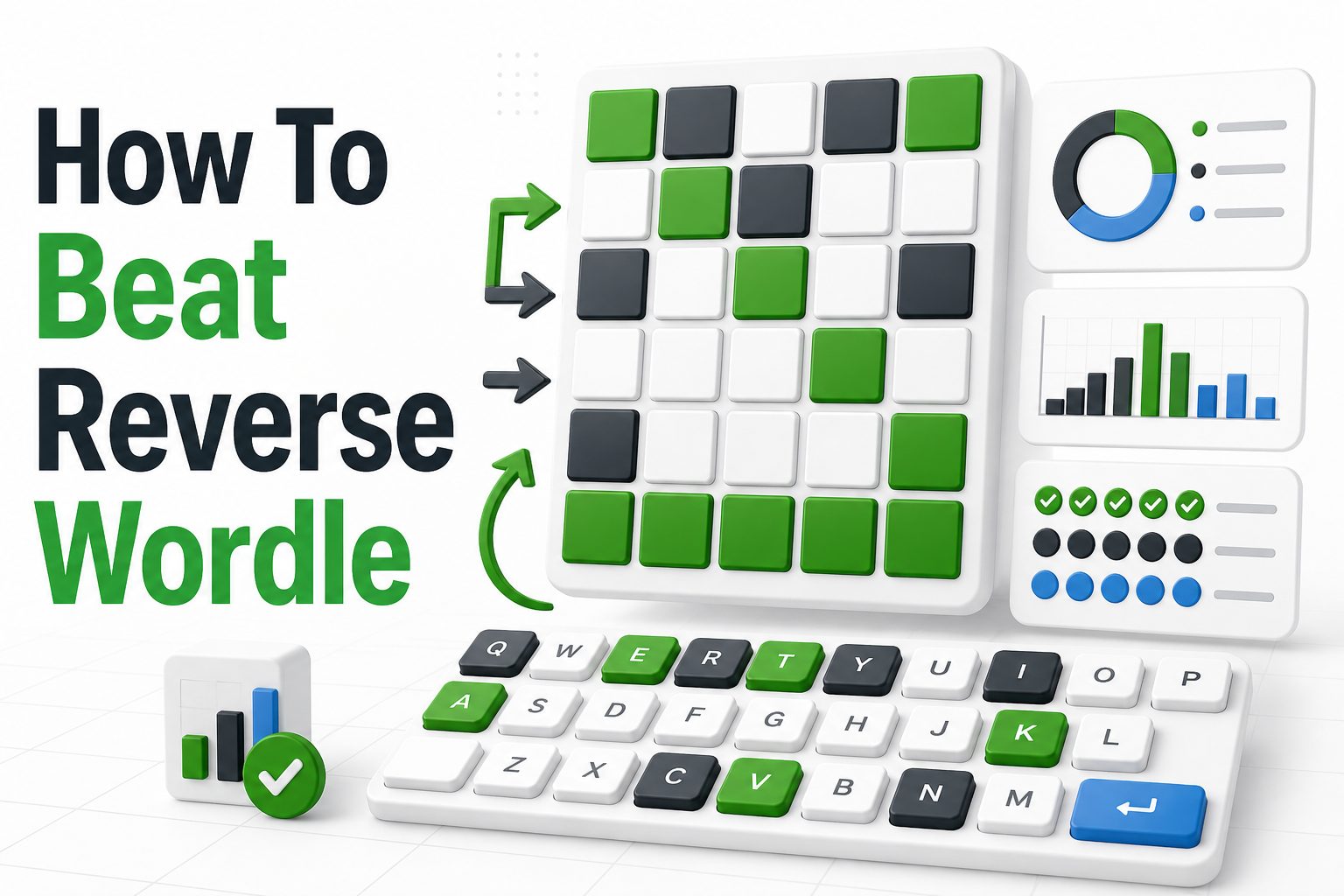
If regular Wordle rewards you for narrowing down one hidden answer, Reverse Wordle flips the pressure in a way that feels sharper and less forgiving. Instead of simply guessing the secret word, you are often working backward from feedback, constraints, or a known end point. That shift changes how you should think about letters, word structure, and risk.
Learning how to beat reverse wordle is less about having a giant vocabulary and more about controlling information. Strong players do not guess randomly. They manage confirmed letters, avoid wasting turns, and use each clue to reduce the number of possible outcomes. Once you treat the game like a logic puzzle instead of a guessing contest, your results improve quickly.
The key is building a method you can repeat. You need smart opening choices, disciplined clue tracking, and a clear plan for when the puzzle starts to tighten. This guide breaks down the tactics that help you play cleaner, think faster, and win more often.
Why Reverse Wordle Feels Different From Regular Wordle
Reverse Wordle changes the usual rhythm because your goal is not always to find a single hidden word as quickly as possible. Depending on the version, you may need to guide the game toward a target answer or use feedback in the opposite direction. That creates a different kind of pressure.
In regular Wordle, a strong first guess gives broad information. In Reverse Wordle, a strong move also needs to protect future options. A guess that looks useful at first can trap you later if it removes too many flexible letters or creates awkward word patterns.
Build Your Strategy Around Constraints
The best Reverse Wordle players focus on constraints before answers. Every clue tells you what must stay, what must move, and what should be avoided. When you treat those clues as rules, you stop chasing words and start managing the puzzle logically.
Write down or mentally separate confirmed green letters, misplaced yellow letters, and excluded gray letters. This habit prevents repeated mistakes. It also helps you spot when a tempting word is actually illegal because it breaks one of the puzzle’s existing conditions.
Quick Starting Checklist
- Choose words with common vowels and flexible consonants.
- Avoid repeating letters too early unless the puzzle strongly suggests it.
- Track confirmed, misplaced, and eliminated letters separately.
- Do not guess a word just because it fits one clue.
- Think about the next two turns, not only the current guess.
- Use common word endings to narrow the answer pool.
- Change strategy when the puzzle moves from broad testing to precise solving.
Choose Opening Words That Give Useful Control
A good opening word should test high-value letters without creating a narrow path too soon. Words with letters like A, E, R, S, T, L, N, and O are usually helpful because they appear often and connect with many possible word shapes.
Avoid obscure starters that include rare letters unless you have a specific reason. A word packed with Q, X, Z, or J might feel clever, but it usually gives less practical information. Reverse Wordle rewards guesses that leave you with clean, flexible follow-up options.
Use Vowels Early, But Do Not Overuse Them
Vowels shape most five-letter words, so checking them early is useful. A word with two or three different vowels can quickly show whether the answer leans toward patterns like A_E, O_E, or EA. That information can simplify later guesses.
Still, vowels are only part of the puzzle. If you spend too many turns testing vowels, you may fall behind on consonants. Once you know the likely vowel structure, shift attention to common consonants that can form real words around it.
Useful Letter Priority List
High-priority letters:
A, E, O, R, S, T, L, N
Mid-priority letters:
C, D, I, M, P, U, Y
Lower-priority letters:
B, F, G, H, K, V, W
Situational letters:
J, Q, X, Z
This ranking is not a fixed rule. It simply helps you decide which letters deserve early testing when several possible guesses look equally reasonable.
Track Yellow Letters With Extra Care
Yellow letters are often where Reverse Wordle players lose control. A yellow clue means the letter belongs in the word, but not in that position. If you only remember that the letter exists, you may accidentally place it back in a banned spot later.
Create a mental map for yellow letters. For example, if R is yellow in position two, mark R as impossible there but still active elsewhere. This small habit turns confusing feedback into a useful positioning tool.
Do Not Ignore Gray Letters Too Quickly
Gray letters are powerful because they remove possibilities, but they can also mislead you when repeated letters are involved. A gray letter usually means it is absent, yet some Wordle-style games handle duplicate letters in ways that require careful reading.
If a letter appears twice in a guess and only one copy receives feedback, the puzzle may be telling you something specific about quantity. Before removing a letter completely, check whether the feedback came from a duplicate situation.
Comparison Table: Weak Play vs Strong Play
Weak play | Strong play
Guesses familiar words randomly | Chooses words based on clue value
Focuses only on green letters | Tracks green, yellow, and gray letters
Repeats eliminated letters | Avoids letters that cannot help
Uses rare letters too early | Tests common letters first
Solves one turn at a time | Plans likely follow-up guesses
Ignores word patterns | Uses endings, blends, and vowel shapes
Think in Word Families
Word families are groups of words that share similar structures, such as LIGHT, FIGHT, MIGHT, and NIGHT. When you spot a pattern like _IGHT, the puzzle becomes much smaller. You can then focus on testing the first letter efficiently.
This method works especially well in late-game situations. Instead of trying every possible word, identify the shared pattern and choose guesses that separate the remaining options. It saves turns and reduces the risk of guessing between too many similar answers.
Watch for Common Endings
Common endings can make Reverse Wordle easier because English words often cluster around familiar patterns. Endings like -ING, -ATE, -OUND, -IGHT, -ER, and -LY can quickly explain why certain letters keep appearing in feedback.
However, do not force an ending too early. If you decide the word ends in -ING without enough evidence, you may ignore better candidates. Treat endings as strong clues only when multiple letters support the same structure.
Practical Pattern Examples
If A is confirmed in position two:
-
- CARED
- PANEL
- TASTE
- LANCE
If E is confirmed at the end:
-
- SLATE
- CRANE
- SHORE
- BRIDE
If I and G appear as yellow letters:
-
- LIGHT
- GRIND
- BRING
- FIGHT
These examples show how one clue can open several paths. The goal is not to memorize every word, but to train your eye to see likely shapes faster.
Avoid the Trap of One Perfect Guess
Many players search for the perfect guess and waste time doing it. Reverse Wordle is usually won through steady information gain, not one brilliant move. A solid guess that removes three possibilities is often better than a flashy word that confirms very little.
When you feel stuck, ask what the guess will teach you. If it only tests one new idea, it may not be worth the turn. A better guess checks multiple letters, positions, or word families at once.
Use Sacrificial Guesses When Needed
A sacrificial guess is a word you play mainly to gather information, even if you know it probably is not the final answer. This can be useful when several possibilities remain and guessing one by one would be risky.
For example, if the answer could be CATCH, MATCH, PATCH, or WATCH, a test word containing C, M, P, and W may help separate them. The point is to avoid losing turns to blind guesses when a smart test can settle the group.
When to Use a Sacrificial Guess
- You have several possible answers with the same pattern.
- The remaining options differ by only one letter.
- You are not close to running out of turns.
- The test word includes several unresolved letters.
- A direct guess would be mostly luck.
- The puzzle’s rules allow information-focused guesses.
Control Repeated Letters Carefully
Repeated letters can make Reverse Wordle tricky because feedback may look incomplete. Words like LEVEL, EERIE, and SHEEP require you to think about letter quantity as well as position. One confirmed letter does not always mean there is only one copy.
Do not assume duplicates until the clue pattern supports them. At the same time, do not rule them out late in the game. If every normal word fails, a repeated letter may be the missing piece that explains the feedback.
Recognize When a Letter Is Overrepresented
If a guess contains two copies of the same letter and only one receives a positive clue, the game may be limiting that letter to one appearance. This can remove a surprising number of possible answers.
For instance, if you guess SHEEP and only one E is marked useful, avoid building future guesses around double E unless other clues support it. Careful quantity tracking prevents repeated-letter puzzles from becoming messy.
Smart Guessing Rules
- Test duplicate letters only when the board suggests them.
- Treat mixed feedback on duplicate letters as quantity information.
- Do not use the same eliminated letter in multiple later guesses.
- Separate position clues from existence clues.
- Review all previous feedback before making a late guess.
- Use common duplicate patterns like LL, EE, OO, and SS only with evidence.
Learn From Failed Guesses
Every failed guess still has value if you study it properly. The mistake is treating a wrong word as a dead end. A failed guess may eliminate a letter, prove a position impossible, or show that a word family is unlikely.
After each guess, pause briefly before typing the next word. Ask which letters changed status and which positions are now blocked. This short review keeps your next move grounded in evidence instead of frustration.
Keep a Clean Mental Board
A clean mental board means you always know three things: confirmed letters, possible letters, and impossible placements. If those categories blur together, Reverse Wordle becomes much harder than it needs to be.
Some players benefit from jotting letters on paper, especially when learning how to beat reverse wordle consistently. Others use a notes app or simply rehearse the clues aloud. The format does not matter as much as the discipline of tracking.
Simple Board Tracking Format
Confirmed positions:
1 _ 2 A 3 _ 4 _ 5 E
Misplaced letters:
R cannot be position one
T cannot be position four
Eliminated letters:
B, K, M, O
Possible next tests:
S, L, N, C, D
This type of layout helps you avoid memory errors and makes your next guess easier to choose.
Use Probability Without Becoming Mechanical
You do not need advanced math to play well, but probability helps. Common letters, common positions, and common endings should influence your choices. For example, S is more likely at the start of a word than X, while E often appears near the end.
The trick is balancing probability with actual clues. A common letter is not useful if the puzzle has already ruled it out. Strong play combines language instinct with strict attention to feedback.
Favor Realistic Words Over Rare Options
When two words fit the clues, choose the one that is more likely to be used in a Wordle-style puzzle. Most versions prefer common, recognizable words over technical terms, obscure plurals, or unusual proper nouns.
This does not mean rare words never appear. It means your first serious answer should usually be the natural word. Save strange possibilities for when common options no longer fit the clue pattern.
Common Word Signals
- The word uses familiar letter combinations.
- The vowel pattern appears in many everyday words.
- The answer is not a proper noun.
- The word can stand alone without special context.
- The spelling does not rely on rare borrowed forms.
- The ending matches common English structure.
Plan Two Moves Ahead
A good Reverse Wordle guess should set up the next turn. Before submitting a word, think about what you will do if the main letters turn green, yellow, or gray. If every possible result leaves you confused, choose a cleaner test.
Planning ahead reduces panic in tight puzzles. It also helps you avoid guesses that feel useful but create no clear follow-up. The best moves give you a path forward no matter how the feedback lands.
Use Branching Logic
Branching logic means preparing different responses for different clue outcomes. If S turns green, you test one family. If it turns gray, you move toward another. This keeps your thinking organized and fast.
You do not need to map every possibility. Just identify the two or three most likely outcomes before playing. That habit makes you more deliberate and keeps late-game decisions from becoming rushed guesses.
Two-Move Planning Example
Current clues:
A is in position two
E is in position five
R is in the word but not position three
Possible guess:
LARGE
If L is green, test LAR_E patterns.
If G is gray, remove words with G.
If R is yellow again, shift R to position four or five.
If E stays confirmed, keep the ending stable.
This simple forecast gives your next turn structure before the feedback appears.
Know When to Stop Testing and Start Solving
Early in the game, testing is smart. Later, too much testing can cost you the win. Once you have enough confirmed structure, shift from broad information gathering to choosing likely answers.
A useful rule is to start solving when only a few word families remain. If your clues strongly point to a pattern like _RA_E, direct guesses may be better than another broad test. Timing matters as much as vocabulary.
Read the Board Like a Filter
Think of the board as a filter that every candidate word must pass. Does the word keep green letters in place. Does it move yellow letters away from banned spots. Does it avoid gray letters. Does it match known letter counts.
If a word fails any of those checks, reject it quickly. This keeps your options clean and prevents emotional guessing. For more help with puzzle habits, see [Internal Link: Word Game Strategy].
Late-Game Filter Checklist
- All green letters stay fixed.
- Yellow letters appear in new legal positions.
- Gray letters are fully excluded.
- Repeated letters match the feedback.
- The word is common enough to be plausible.
- The guess separates similar remaining options.
- The move fits the number of turns left.
Practice With Post-Game Review
The fastest way to improve is reviewing one or two key moments after each game. Look at where your guesses became inefficient. Did you repeat a gray letter. Did you ignore a yellow position rule. Did you chase a low-probability word too early.
Post-game review should be short and practical. You are not trying to analyze every move perfectly. You are looking for one habit to fix next time. Small corrections add up quickly across repeated games.
Build a Personal Word Bank
A personal word bank gives you reliable guesses for different situations. Keep a few strong starters, vowel testers, consonant testers, and pattern words ready. This saves mental energy and helps you avoid weak guesses under pressure.
Your word bank should grow from real games. When a word gives useful information, keep it. When a starter repeatedly leaves you stuck, replace it. For broader puzzle planning, you can also use [Internal Link: Daily Word Puzzle Tips].
Sample Personal Word Bank
Opening words:
CRANE
SLATE
ROAST
LATER
Vowel testers:
AUDIO
LOUIE
RAISE
Consonant testers:
STERN
CLAMP
BRINK
SHOUT
Pattern helpers:
LIGHT
PLANE
ROUND
TRACE
These are not magic answers. They are flexible tools that help you respond faster when the clue pattern starts taking shape.
Common Mistakes That Make Reverse Wordle Harder
One common mistake is guessing words that satisfy only part of the clue set. A word may include a confirmed letter but place a yellow letter incorrectly or reuse a gray letter. That kind of mistake wastes a turn and damages your position.
Another mistake is changing strategy too often. Some players test broadly, then guess randomly, then return to testing with no clear reason. Reverse Wordle rewards steady logic. Each move should connect to the clues already on the board.
Avoid Emotional Guessing
Emotional guessing happens when frustration takes over. You see a possible answer, type it quickly, and hope it works. Sometimes it does, but over time this habit costs more games than it saves.
When you feel stuck, slow down for ten seconds. Recheck the rules the board has given you. Most difficult puzzles become easier once you remove impossible words and focus only on valid candidates.
Mistakes to Cut From Your Game
- Reusing eliminated letters without a reason.
- Forgetting where yellow letters cannot go.
- Assuming a word family too early.
- Ignoring repeated-letter clues.
- Picking rare words before common ones.
- Guessing directly when a test word would be smarter.
- Testing too long when the answer pool is already small.
Conclusion
Winning at Reverse Wordle comes down to calm, structured thinking. Strong players do not rely on lucky guesses or memorized word lists alone. They gather useful clues, track positions carefully, and shift from testing to solving at the right moment. That simple discipline turns a confusing puzzle into a manageable one.
The most reliable approach is to start with flexible words, respect every clue, and use each guess to reduce uncertainty. Pay close attention to yellow letters, repeated letters, and common word patterns. When several answers remain, use a smart test instead of guessing blindly. When the answer pool is small, commit to solving.
If you want to know how to beat reverse wordle, focus less on speed and more on clean decisions. The puzzle rewards players who think one step ahead, avoid careless repeats, and let the clues guide every move.
FAQ
What is the best first word for Reverse Wordle?
A strong first word uses common letters and at least two vowels. Words like CRANE, SLATE, ROAST, or LATER work well because they test useful letters while leaving many possible follow-up guesses open.
Should I use the same starter every time?
Using one reliable starter can build consistency, but it is worth having several options. Different starters help you practice varied clue patterns and prevent you from depending too much on one opening structure.
How do yellow letters work in Reverse Wordle?
A yellow letter usually means the letter belongs in the word but not in that position. Track both facts together. The letter remains useful, but that exact placement should be avoided in later guesses.
Are repeated letters common in Reverse Wordle?
Repeated letters appear often enough that you should watch for them, especially late in the game. Do not assume duplicates early, but consider them when normal single-letter options no longer fit the feedback.
How can I improve faster at Reverse Wordle?
Review your mistakes after each game. Look for repeated gray letters, ignored yellow positions, weak starters, or guesses with little clue value. Fixing one habit at a time improves your results faster than memorizing random words.
0 Comments